Shopify Website Design & Store Builds
What it takes to build a Shopify website that actually sells, from someone who just finished one: 565 products, 46 categories, and a checkout that works. Not a template, and not a demo store.
What you get from a Shopify developer who has actually shipped one
Plenty of people list themselves as a Shopify developer. Fewer can point at a live store with hundreds of real products in it. I build, launch, and hand over Shopify stores for small businesses, and the most recent one is public: 565 parts, 46 categories, and a checkout that finally takes a card. You own the store outright when it ships. There is no monthly fee to me for the build.
Selling online is three jobs, not one
Putting products on a website sounds like a single task. It is actually three. You have to get the products in, organize them so a customer can find the one thing they need, and take money without the checkout falling over. Most stores that struggle are fine on the first one and broken on the other two.
- Getting the catalog in. Products, variants, photos, prices, stock. Tedious, and the part everyone thinks is the whole job.
- Organizing it. The real work, and the part that decides whether anyone ever finds what they came for.
- Taking the money. Where the leaks are, and where a bad decision quietly costs you orders for years.
A real build: 565 parts for tractors made before 1940
Rice Equipment sells new old-stock parts for vintage Farmall and McCormick-Deering tractors, the kind built between 1921 and 1939, to customers all over the country. Their old site was dated, and more importantly the checkout did not work. People who wanted to buy could not. The rebuild is live now at riceequipmentinc.com: 565 products across 46 categories, on Shopify.
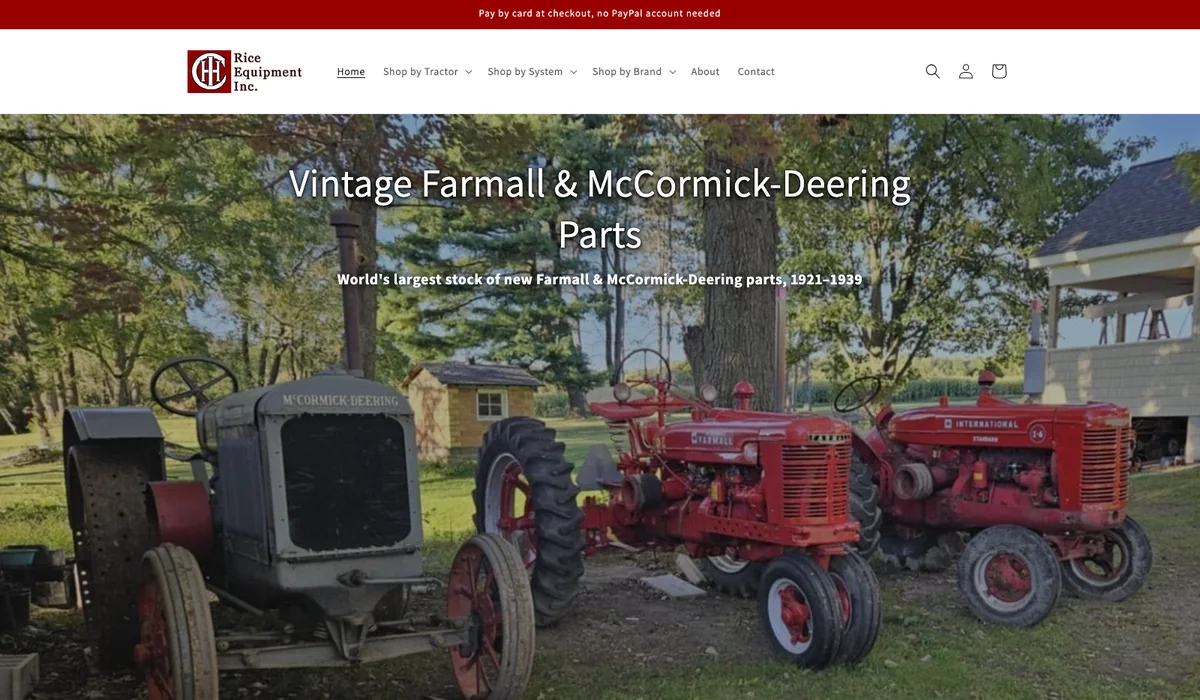
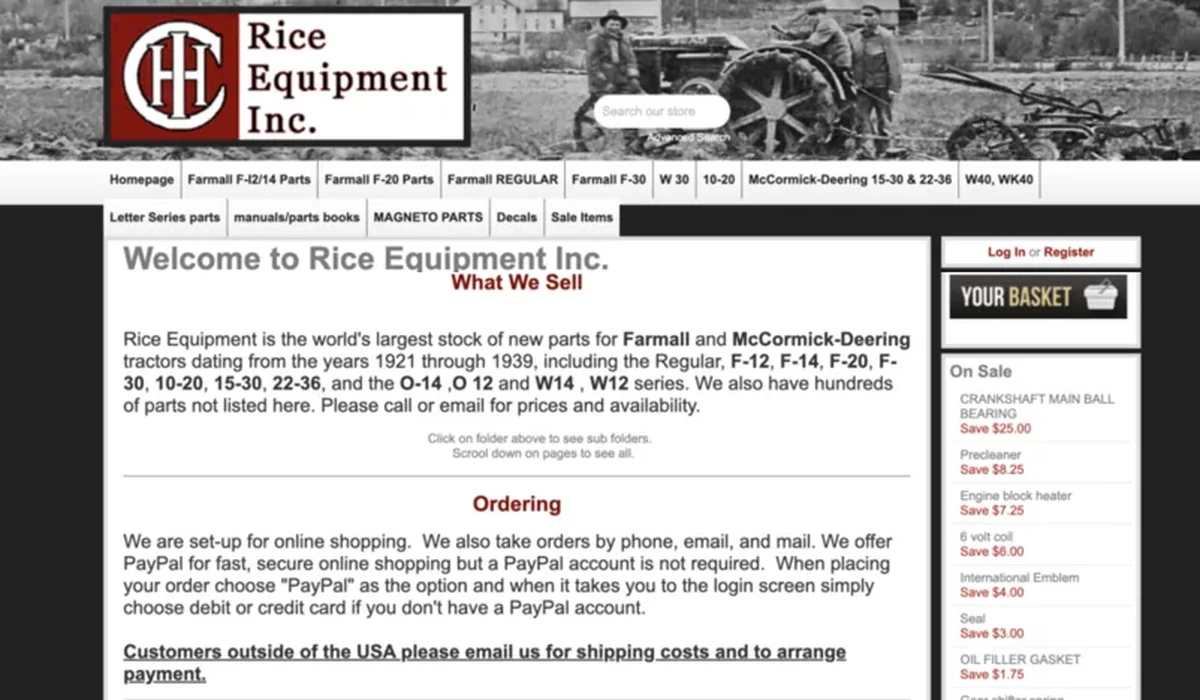 BeforeAfter
Drag or tap to compare: the old site vs. the new Shopify store.
The hard part is the organizing, not the design
Here is the thing nobody tells you about a product catalog. Somebody restoring a Farmall F-12 does not browse. They need one specific governor spring, and if they cannot find it in about thirty seconds they leave and call someone on the phone.
So the catalog got organized three different ways, because customers arrive knowing three different things:
- By tractor. They know they have an F-14, or a Farmall Cub, or a W-30. That is the most common way in.
- By system. They know it is an ignition problem, or a fuel system part, or brakes, but not the part number.
- By brand. They only know it is a McCormick-Deering.
Same 565 products, three paths in. That is most of the work on a Shopify build, and it is invisible when it is done right. It is also the difference between a store that sells and a catalog that just sits there.
Checkout is where the money leaks
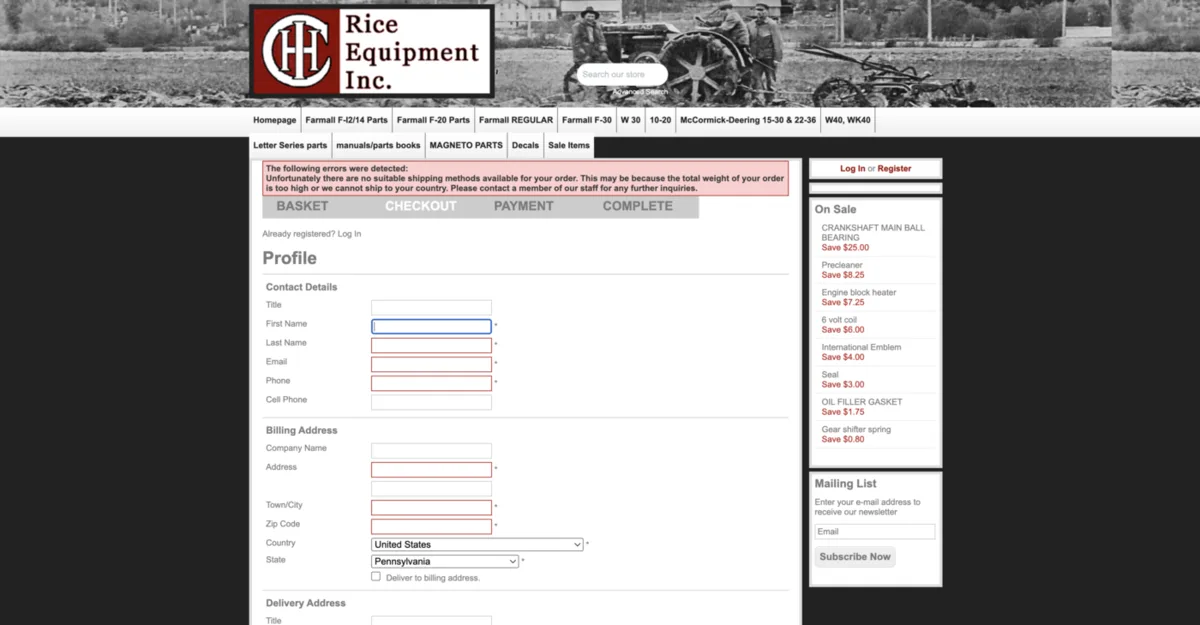
A broken or awkward checkout undoes everything upstream. Rice's old one threw “no suitable shipping methods available” errors, which meant online ordering simply did not work. Every visitor who wanted to buy got turned away.
The other common version I see is a store that forces the customer to create an account with a third-party payment service before they can pay. A lot of people, especially older customers, simply stop there. Rice's store now says it plainly at the top of every page: pay by card at checkout, no extra account needed. That one sentence exists because it removes the exact objection that was costing them orders.
What a Shopify build costs
A store is more work than a brochure site and the price should reflect that, but not by as much as agencies suggest. A real store with a product catalog is commonly quoted at $5,000 and up. I price by what the job actually takes, which mostly comes down to how many products there are and what shape your product data is in. Every quote is detailed and up front, and nothing gets added to your bill without your okay.
Common questions
How much does it cost to build a Shopify website?
It depends on two things: how many products you have, and what shape your product data is in. If you already have a clean spreadsheet of your inventory, you are most of the way there. If it lives in a filing cabinet, that is the real cost. A store with a full product catalog is commonly quoted at $5,000 and up. I price by what the job actually takes and you get a detailed quote up front, with nothing added without your okay. Starting rates are on the pricing page.
How long does a Shopify build take?
A small catalog can be live in a few weeks. A large one takes longer, and the biggest variable is almost always how quickly the product data comes together, not the design. Rice Equipment was 565 products across 46 categories, and the catalog work was most of the project.
Can you move my existing store onto Shopify?
Yes, that is exactly what the Rice Equipment build was. Their old site had a checkout that threw errors, so customers could not actually place an order. Everything moved onto Shopify: the products, the categories, and a checkout that takes a card without sending anyone to a third-party account first.
Do I actually need Shopify, or just a regular website?
Plenty of businesses ask for a store and do not need one. If you sell services, or a handful of items you mostly discuss on the phone first, a regular website with an easy way to contact you will outperform a store you have to maintain. Ecommerce earns its keep when you have real inventory, repeat buyers, and orders you would rather not take by phone one at a time. I will tell you honestly which one you need, even when the store is the bigger project.
Tell me what you sell
Send me what you sell and roughly how many products you have, and I'll tell you what a build would take. If a simpler website serves you better than a store, I will say so, even though the store is the bigger project. If you want the longer walkthrough first, the full ecommerce breakdown is here.